
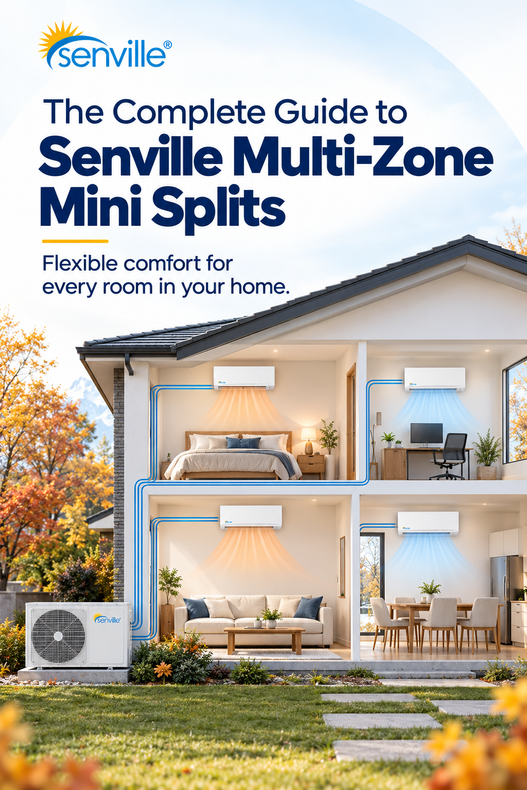
Heating and cooling multiple rooms doesn't always mean installing a separate outdoor unit for every space. With a Senville multi-zone mini split system, you can connect several indoor units to one outdoor unit, giving different areas of your home their own temperature settings.
But how many indoor units can you connect? Can you combine a wall-mounted mini split with a ceiling cassette? And how do you know which sizes will work together?
Whether you're planning a system for bedrooms, living areas, or a combination of spaces, understanding your options is an important first step.
In this guide, we'll explain how Senville multi-zone systems work, which indoor units are compatible, and what to consider before choosing your configuration.
Quick Answer: Can You Mix Different Indoor Units in a Senville Multi-Zone System?
Yes! Senville multi-zone systems allow you to combine compatible indoor-unit styles, including wall-mounted, ceiling cassette, concealed ducted, and floor-mounted units.
Depending on the outdoor-unit model, you can connect multiple indoor units to one outdoor unit. Each indoor unit must be compatible with your specific system, and the combination must meet the manufacturer's capacity and installation requirements.
1. What Is a Multi-Zone Mini Split System?
A multi-zone mini split is a ductless heating and cooling system that connects multiple indoor units to a single outdoor condenser.
Unlike a single-zone system, which typically serves one indoor area, a multi-zone system is designed to condition several spaces.
For example, a home might use:
- A wall-mounted unit in the living room
- A ceiling cassette in an open-concept kitchen
- A concealed ducted unit serving a bedroom area
- A floor-mounted unit in a room with limited upper-wall space
Each indoor unit can have its own temperature setting, allowing you to adjust comfort based on how different rooms are used.
Important: While individual rooms can have different temperature settings, indoor units connected to the same outdoor unit must operate in the same heating or cooling mode.
Multi-zone systems can be particularly useful when you want room-by-room comfort without installing a separate outdoor condenser for every indoor unit.
2. How Many Indoor Units Can You Connect?
The number of indoor units you can connect depends on the Senville outdoor-unit model.
Some systems support three indoor units, while larger configurations can accommodate additional indoor units.
Senville Multi-Zone Outdoor Unit Options
| Outdoor Unit Model | Maximum Indoor Units | Pre-Charged Total Line Length | Maximum Line Length Per Indoor Unit |
|---|---|---|---|
| 18HF-MOA | 3 | 75 ft | 98.4 ft |
| 28HF-MOA | 4 | 100 ft | 114.8 ft |
| 36HF-MOA | 5 | 125 ft | 114.8 ft |
| 48HF-MOA | 6 | 150 ft | 114.8 ft |
The maximum number of connections is only one part of choosing a system. You also need to consider the heating and cooling requirements of each room, the capacity of the outdoor unit, and the distance between indoor and outdoor equipment.
Good to Know: If your installation requires refrigerant lines beyond the factory pre-charged length, additional refrigerant may be necessary. This must be handled by a licensed HVAC technician.
For complete model-specific details, refer to the Senville Multi-Zone Compatibility Guide.
3. Which Senville Indoor Units Are Compatible With Multi-Zone Systems?
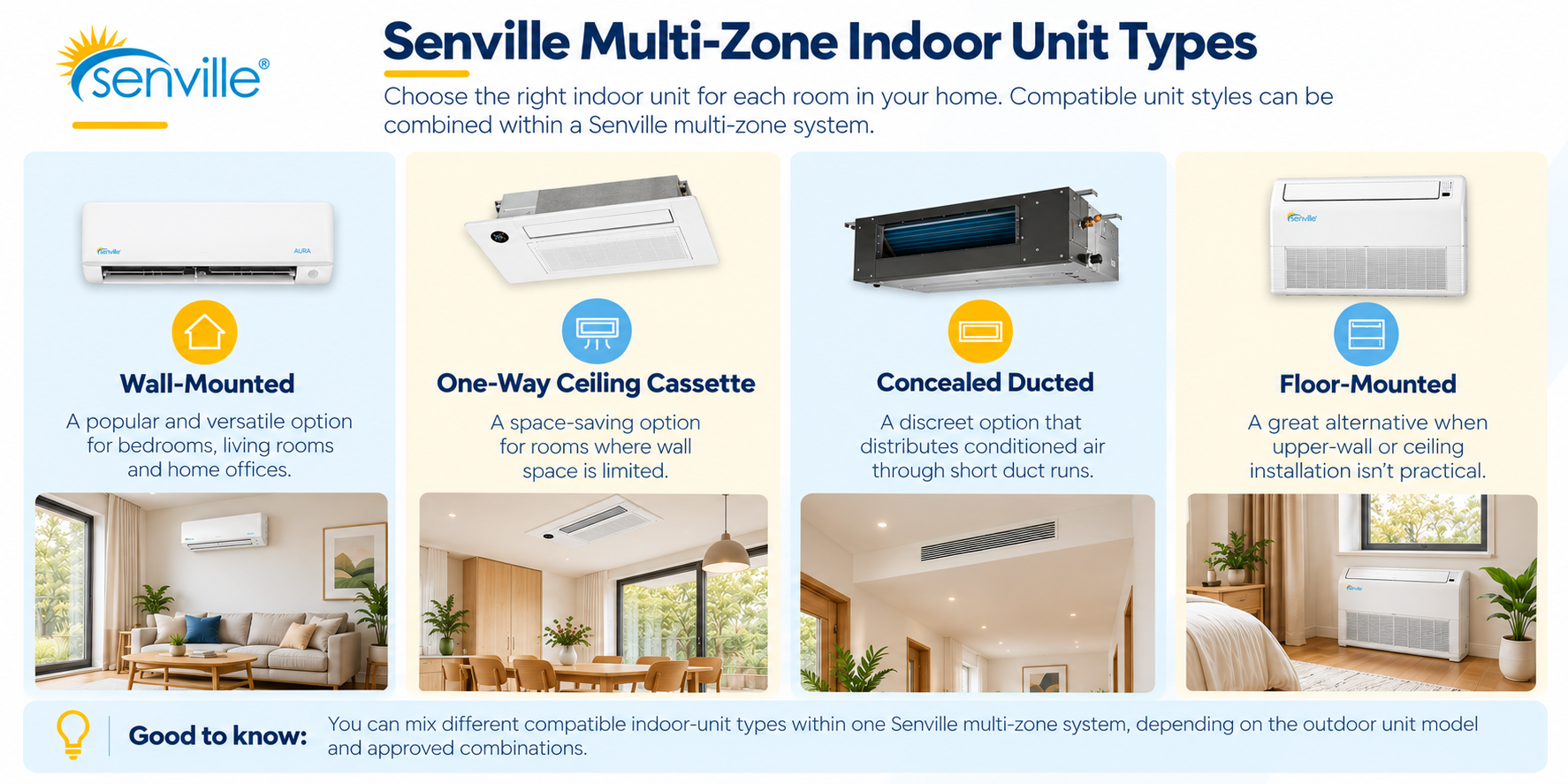
One of the advantages of a Senville multi-zone system is the ability to choose from different indoor-unit styles.
Rather than selecting equipment based only on appearance, consider the room's layout, available installation space, and heating and cooling needs.
Wall-Mounted Indoor Units
Wall-mounted mini splits are a familiar option for bedrooms, living rooms, home offices, and other residential spaces.
Installed high on an interior wall, they deliver conditioned air directly into the room without requiring traditional ductwork.
Consider a wall-mounted unit when:
- You have sufficient upper-wall space.
- You want a straightforward ductless installation.
- You need heating and cooling for an individual room.
Senville offers multi-zone-compatible wall-mounted indoor units in several capacities.
Ceiling Cassette Indoor Units
Ceiling cassette units are designed for installation within a compatible ceiling space.
They offer an alternative to wall-mounted equipment, particularly in rooms where wall space is limited or a ceiling-mounted appearance is preferred.
Senville offers both one-way and four-way ceiling cassette options for compatible multi-zone configurations.
Consider a ceiling cassette when:
- You want to preserve wall space.
- Your room has suitable ceiling clearance.
- You prefer an overhead air-distribution option.
The appropriate cassette type will depend on the room layout, ceiling construction, and system compatibility.
Concealed Ducted Indoor Units
Concealed ducted indoor units offer another option for homeowners who prefer less visible equipment.
These units are installed within a suitable concealed space and distribute conditioned air through short duct runs.
They can be useful when the room layout allows for ductwork, but a traditional wall-mounted indoor unit isn't the preferred choice.
Consider a concealed ducted unit when:
- You want to minimize visible indoor equipment.
- You have suitable space for the unit and ductwork.
- Your project allows for the additional installation requirements.
Duct design, airflow, and available installation space should all be evaluated before choosing this configuration.
Floor-Mounted Indoor Units
Floor-mounted indoor units provide an alternative when upper-wall or ceiling installation isn't practical.
They are generally positioned lower on the wall and can be useful in spaces with sloped ceilings, limited upper-wall clearance, or other layout considerations.
Consider a floor-mounted unit when:
- Upper-wall space is limited.
- The room layout makes a lower installation more practical.
- You want another indoor-unit placement option.
Before selecting a floor-mounted unit, confirm that the exact model is approved for your chosen multi-zone outdoor system.
Choosing the Right Indoor Unit
| Indoor Unit Type | Installation Location | Main Consideration |
|---|---|---|
| Wall-mounted | High on a wall | Available wall space and airflow |
| One-way ceiling cassette | Recessed into a ceiling | Ceiling clearance and directional airflow |
| Four-way ceiling cassette | Recessed into a ceiling | Ceiling clearance and room layout |
| Concealed ducted | Hidden within a suitable space | Ductwork and airflow design |
| Floor-mounted | Lower wall area | Room layout and installation clearance |
The Takeaway: You don't necessarily need to use the same indoor-unit style in every room. The goal is to choose compatible equipment that fits the space and meets its heating and cooling requirements.
4. Can You Mix Different Indoor Unit Types?
Yes. You can combine different compatible indoor-unit styles within one Senville multi-zone system.
For example, you might prefer a wall-mounted unit in a bedroom but want a ceiling cassette in your living area.
As long as the indoor units are approved for the same outdoor system and the configuration meets the required specifications, different styles can work together.
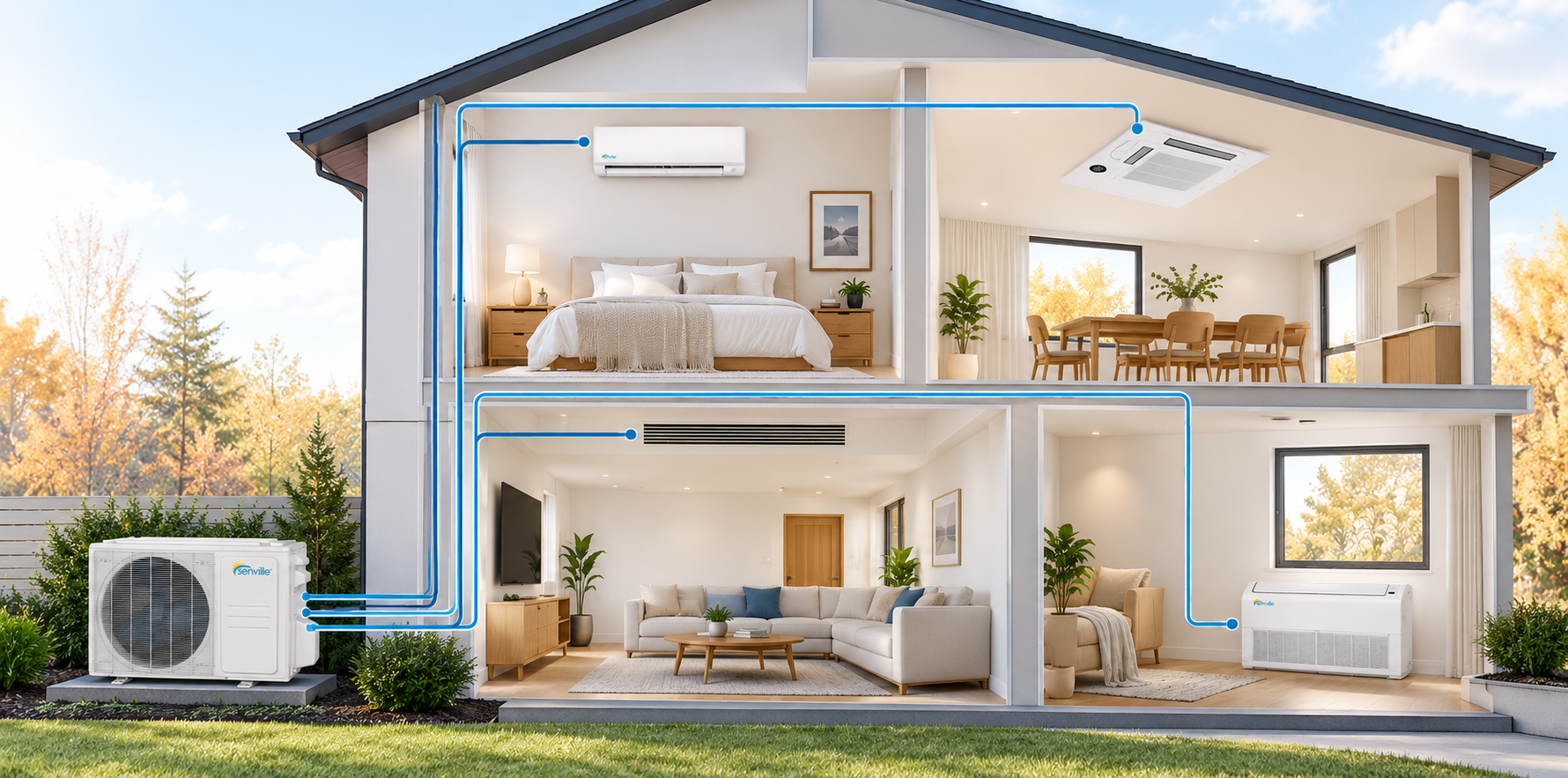
Example: A Multi-Zone Setup for Three Rooms
Imagine you're planning heating and cooling for three areas of your home.
| Room | Indoor Unit Type | Why You Might Choose It |
|---|---|---|
| Living room | Wall-mounted | A practical option for an open wall |
| Bedroom | One-way ceiling cassette | Keeps wall space available |
| Home office | Concealed ducted | Offers a less visible installation |
This example illustrates potential indoor-unit styles, not a confirmed equipment combination. Verify model numbers, capacities, and compatibility before purchasing.
Planning Tip: Start by identifying the rooms you want to heat and cool. Then consider the best indoor-unit style for each space before selecting the outdoor system.
5. Understanding BTU Capacity and Multi-Zone Sizing
When choosing a multi-zone mini split, it's important to understand the difference between the capacity of an individual indoor unit and the capacity of the outdoor system.
BTU stands for British Thermal Unit. In HVAC equipment, BTU/h is commonly used to describe heating or cooling capacity.
An indoor unit's capacity should be selected based on the room's heating and cooling requirements.
Factors that influence sizing include:
- Room dimensions and ceiling height
- Insulation levels
- Window size and sun exposure
- Local climate
- Air leakage and building construction
- How the space is used
A larger room doesn't automatically need the largest available indoor unit. Proper sizing helps ensure the system can meet the space's heating and cooling needs.
Can the Combined Indoor BTUs Exceed the Outdoor Unit's Rating?
Yes, in some approved configurations.
Senville multi-zone systems can support combinations where the total nominal capacity of the indoor units exceeds the outdoor unit's nominal rating.
This is possible because individual rooms don't always require their maximum heating or cooling output at the same time.
Important: Not every capacity combination is acceptable, and indoor units may not all deliver their full rated capacity simultaneously. Always follow the approved combination limits for your outdoor-unit model.
The combined indoor capacity must remain within the permitted range for the selected outdoor unit.
For this reason, it's important to review the manufacturer's approved combinations and have the system sized for the home's actual heating and cooling loads.
6. Important Compatibility Rules to Know
Before purchasing indoor units for a multi-zone system, there are a few important rules to understand.
Rule 1: Indoor Units Must Be Multi-Zone Compatible
Not every Senville indoor unit is designed to connect to a multi-zone outdoor condenser.
A single-zone indoor unit cannot automatically be added to a multi-zone system, even if it has a similar appearance or BTU rating.
Always verify the exact indoor and outdoor model numbers.
Rule 2: All Indoor Units Must Use the Same Operating Mode
Although each room can have its own temperature setting, connected indoor units cannot operate in heating and cooling modes simultaneously.
For example, you cannot have one bedroom cooling while another room is heating if both units share the same outdoor condenser.
If conflicting modes are selected, the system may display a mode-conflict indication such as "--".
Good to Know: Individual temperature control doesn't mean independent heating and cooling modes. Connected rooms must follow the same general operating mode.
Rule 3: Refrigerant Types Must Match
Senville equipment using R410A refrigerant cannot be mixed with equipment designed for R454B.
When purchasing replacement indoor units or building a new configuration, confirm the refrigerant type and compatibility of all components.
Rule 4: Installation Limits Still Apply
Every system has installation requirements, including:
- Maximum refrigerant line lengths
- Total allowable line length
- Refrigerant charge requirements
- Approved indoor-unit combinations
- Electrical and installation specifications
A licensed HVAC professional should verify the installation requirements and complete the necessary refrigerant work.
For additional model information, visit the Senville Support Center.
7. Multi-Zone vs. Multiple Single-Zone Systems: What's the Difference?
If you're planning heating and cooling for several rooms, you may be deciding between one multi-zone system and multiple single-zone mini splits.
Both approaches have advantages, depending on your home and comfort needs.
| Consideration | Multi-Zone System | Multiple Single-Zone Systems |
|---|---|---|
| Outdoor equipment | One outdoor unit serves multiple indoor units | Each system has its own outdoor unit |
| Room temperatures | Individual temperature settings | Individual temperature settings |
| Heating and cooling modes | Connected units must use the same operating mode | Separate systems can operate independently |
| Indoor-unit styles | Compatible styles can be mixed | Depends on each single-zone system |
| Installation planning | Shared outdoor capacity and refrigerant connections | Separate systems and connections |
A multi-zone system may be appealing when you want to reduce the number of outdoor units and serve several rooms from one system.
Multiple single-zone systems may be worth considering when different areas need completely independent heating and cooling operation.
The best option depends on your home's layout, installation conditions, heating and cooling loads, and comfort preferences.
Explore Senville Multi-Zone Mini Split Systems
8. How to Plan Your Senville Multi-Zone System
Ready to start planning? Here's a simple way to approach your configuration.
Step 1: Identify the Rooms
Make a list of the spaces you want to heat and cool. Consider whether you need conditioning in every room or only certain areas of the home.
Step 2: Determine Each Room's Heating and Cooling Requirements
Before choosing equipment, have the heating and cooling loads calculated. This helps determine the appropriate indoor-unit capacity for each space.
Step 3: Choose Your Preferred Indoor-Unit Styles
Think about the installation possibilities in each room. Would a wall-mounted unit work best? Is there suitable ceiling space for a cassette? Would a concealed ducted option better fit the layout?
Step 4: Select a Compatible Outdoor Unit
Once you know the number of indoor units and their required capacities, choose an outdoor system that supports the configuration. Check the maximum number of connections, approved capacity combinations, and installation limits.
Step 5: Review Installation Requirements
Consider the location of the outdoor condenser, refrigerant line routing, electrical requirements, and access for future maintenance. A licensed HVAC professional can help confirm that the planned system meets the necessary requirements.
Step 6: Explore Senville's Build Your Own Options
Once you've narrowed down your requirements, explore compatible indoor and outdoor equipment through Senville's Build Your Own selection.
Ready to Plan Your Multi-Zone System?
Explore Senville's available configurations and indoor-unit options.
Build Your Own Multi-Zone System →9. Frequently Asked Questions About Senville Multi-Zone Mini Splits
10. Build a Multi-Zone System That Fits Your Home
Every home has different heating and cooling needs. That's why choosing a multi-zone mini split system involves more than simply deciding how many indoor units you want.
From wall-mounted units to ceiling cassettes and concealed ducted options, Senville offers a range of compatible indoor-unit styles that can be combined to suit different spaces.
The key is to select the right indoor units, confirm compatibility with your outdoor system, and ensure the entire configuration is properly sized.
Whether you're planning comfort for two rooms or several areas throughout your home, we're here to help you explore your options.
Find the Right Multi-Zone Setup for Your Home
Explore Senville multi-zone systems and start building a configuration that fits your space.
Explore Multi-Zone Systems →