
Choosing between the Senville AURA and Elite Series isn't simply about selecting the system with the highest efficiency rating. Both are cold-climate ductless heat pumps designed to provide heating and cooling, but their performance differences become clearer when you compare specific capacities.
For example, the Elite Series offers higher SEER2 ratings across all four capacities in this comparison, while the AURA 24,000 BTU system delivers greater heating output at several outdoor temperatures.
Understanding those differences can help homeowners and HVAC professionals evaluate which system better matches a home's heating needs, efficiency priorities, and comfort expectations.
Quick Answer: AURA vs. Elite — Which Is Better?
Both Senville AURA and Elite are cold-climate mini splits, but their performance advantages depend on the system size. Elite offers higher cooling efficiency (SEER2) across all four capacities and stronger extreme-cold heating output at 9K, 12K, and 18K. At 24K, AURA delivers greater cold-weather heating output and a lower listed minimum sound level. The best choice depends on your home's heating needs, climate, and efficiency priorities.
What You'll Learn
- How AURA and Elite compare in energy efficiency
- Which series delivers more heating output in cold weather
- How performance changes between 9K, 12K, 18K, and 24K systems
- What sound ratings mean when comparing equipment
- Why proper sizing matters more than choosing a series by name
- Which factors to consider before selecting your Senville system
1. AURA vs. Elite: What's the Main Difference?
Both AURA and Elite are designed for year-round comfort, including operation in cold climates.
The distinction comes down to how individual models perform.
Senville Elite Series
The Elite models evaluated in the technical comparison offer higher SEER2 ratings across all four capacity classes. At 9K, 12K, and 18K, Elite also delivers greater heating output at the low outdoor temperatures examined.
Senville AURA Series
AURA remains a strong cold-climate option, particularly when heating capacity is a priority. In the 24K comparison, AURA delivers greater heating output at 17°F, 5°F, and -22°F, along with a lower listed minimum sound level.
Neither series is automatically the better choice for every application. The exact model and the home's heating requirements matter.
2. Comparing Energy Efficiency: SEER2 and HSPF2
Two ratings are especially useful when comparing heat pumps.
SEER2 (Seasonal Energy Efficiency Ratio 2) measures seasonal cooling efficiency. A higher SEER2 rating indicates greater cooling efficiency under standardized testing conditions.
HSPF2 (Heating Seasonal Performance Factor 2) measures seasonal heating efficiency. A higher HSPF2 rating generally indicates more efficient heating performance over the applicable test season.
SEER2 Comparison by Capacity
| Capacity | AURA SEER2 | Elite SEER2 |
|---|---|---|
| 9,000 BTU | 27.4 | 33.3 |
| 12,000 BTU | 25.4 | 29.4 |
| 18,000 BTU | 21.4 | 25.6 |
| 24,000 BTU | 21.0 | 25.0 |
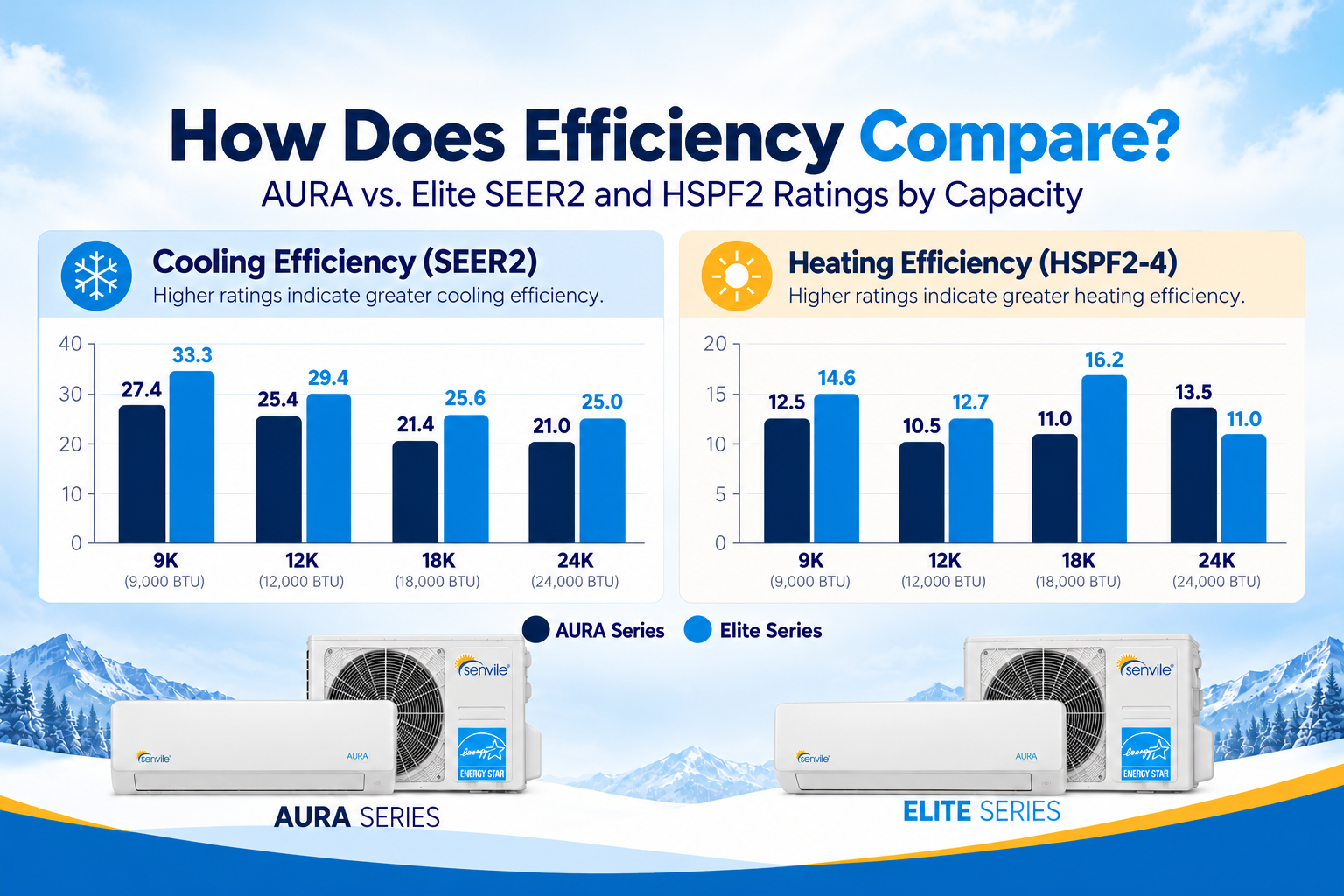
Across all four capacities, the Elite models have higher SEER2 ratings.
The largest listed rating is 33.3 SEER2 for the Elite 9K, compared with 27.4 for the AURA 9K.
However, efficiency isn't determined by SEER2 alone. Heating-focused applications should also consider HSPF2 and available heating output at the temperatures a home experiences.
HSPF2 Comparison
| Capacity | AURA HSPF2-4 | Elite HSPF2-4 |
|---|---|---|
| 9,000 BTU | 12.5 | 14.6 |
| 12,000 BTU | 10.5 | 12.7 |
| 18,000 BTU | 11.0 | 16.2 |
| 24,000 BTU | 13.5 | 11.0 |
Elite leads at 9K, 12K, and 18K, while AURA has the higher HSPF2 rating at 24K.
Quick Answer: If seasonal efficiency is your primary consideration, the Elite models in this comparison offer higher cooling efficiency ratings across every capacity. For heating efficiency, the advantage depends on the size you're comparing.
3. How Do AURA and Elite Perform in Cold Weather?
Cold-climate performance involves more than the lowest outdoor temperature at which a system can operate.
A particularly important measurement is heating output, expressed in BTU/h, at specific outdoor temperatures.
A heat pump may continue operating at extremely low temperatures while delivering less heating capacity than it does under milder conditions.
That's why comparing heating output at 17°F, 5°F, and -22°F can be more informative than looking at operating limits alone.
Heating Output at 5°F
| Capacity | AURA | Elite |
|---|---|---|
| 9K | 11,500 BTU/h | 13,500 BTU/h |
| 12K | 11,500 BTU/h | 13,500 BTU/h |
| 18K | 18,000 BTU/h | 22,600 BTU/h |
| 24K | 24,200 BTU/h | 20,000 BTU/h |
At 5°F, the Elite models provide more heating output at 9K, 12K, and 18K.
At 24K, AURA delivers 24,200 BTU/h compared with 20,000 BTU/h for Elite.
Heating Output at -22°F
| Capacity | AURA | Elite |
|---|---|---|
| 9K | 5,800 BTU/h | 7,500 BTU/h |
| 12K | 5,900 BTU/h | 7,500 BTU/h |
| 18K | 8,000 BTU/h | 11,900 BTU/h |
| 24K | 13,400 BTU/h | 10,200 BTU/h |
These figures highlight why capacity-specific comparisons matter.
The Elite 18K, for example, provides approximately 49% more heating output at -22°F than the AURA 18K in the supplied specifications.
At 24K, the result reverses: AURA provides approximately 31% more heating output at the same outdoor temperature.
Cold-Weather Tip: A system's ability to operate at -22°F doesn't mean it will deliver its full rated heating capacity at that temperature. Compare the published output with your home's calculated heating load.
4. Which Series Is Quieter?
Sound levels can be an important consideration, particularly for bedrooms, home offices, and other spaces where quiet operation matters.
The technical comparison provides the following minimum sound ratings:
| Capacity | AURA | Elite |
|---|---|---|
| 9K | 19.5 dBA | 19.0 dBA |
| 12K | 19.5 dBA | 19.0 dBA |
| 18K | 19.5 dBA | 16.0 dBA |
| 24K | 16.0 dBA | 30.0 dBA |
At 9K and 12K, the listed minimum sound levels are nearly identical. The Elite 18K has a lower listed sound level than its AURA counterpart, while the AURA 24K has a substantially lower listed value than the Elite 24K.
These figures represent the low-quiet operating levels reported in the comparison, not necessarily the sound levels experienced during everyday heating or cooling.
Actual sound levels depend on operating conditions, fan speed, and installation.
5. A Closer Look at Each Capacity
9,000 BTU: Efficiency and Cold-Weather Output
Elite has the advantage in SEER2, HSPF2, and heating output at all three cold-weather temperatures examined. Both models have the same listed rated heating capacity of 12,000 BTU/h.
12,000 BTU: Similar Pattern, Different Efficiency Ratings
Elite again leads in seasonal efficiency and cold-weather heating output. At -22°F, it provides 7,500 BTU/h compared with 5,900 BTU/h for AURA.
18,000 BTU: Notable Differences in Heating Performance
Elite delivers 22,600 BTU/h at 5°F versus 18,000 BTU/h for AURA. It also has the higher HSPF2 rating and lower listed minimum sound level.
24,000 BTU: AURA's Heating Capacity Advantage
AURA delivers greater heating output at every temperature compared in the report, as well as a higher HSPF2 rating and lower listed minimum sound level. Elite maintains the higher SEER2 rating.
6. How to Choose Between AURA and Elite
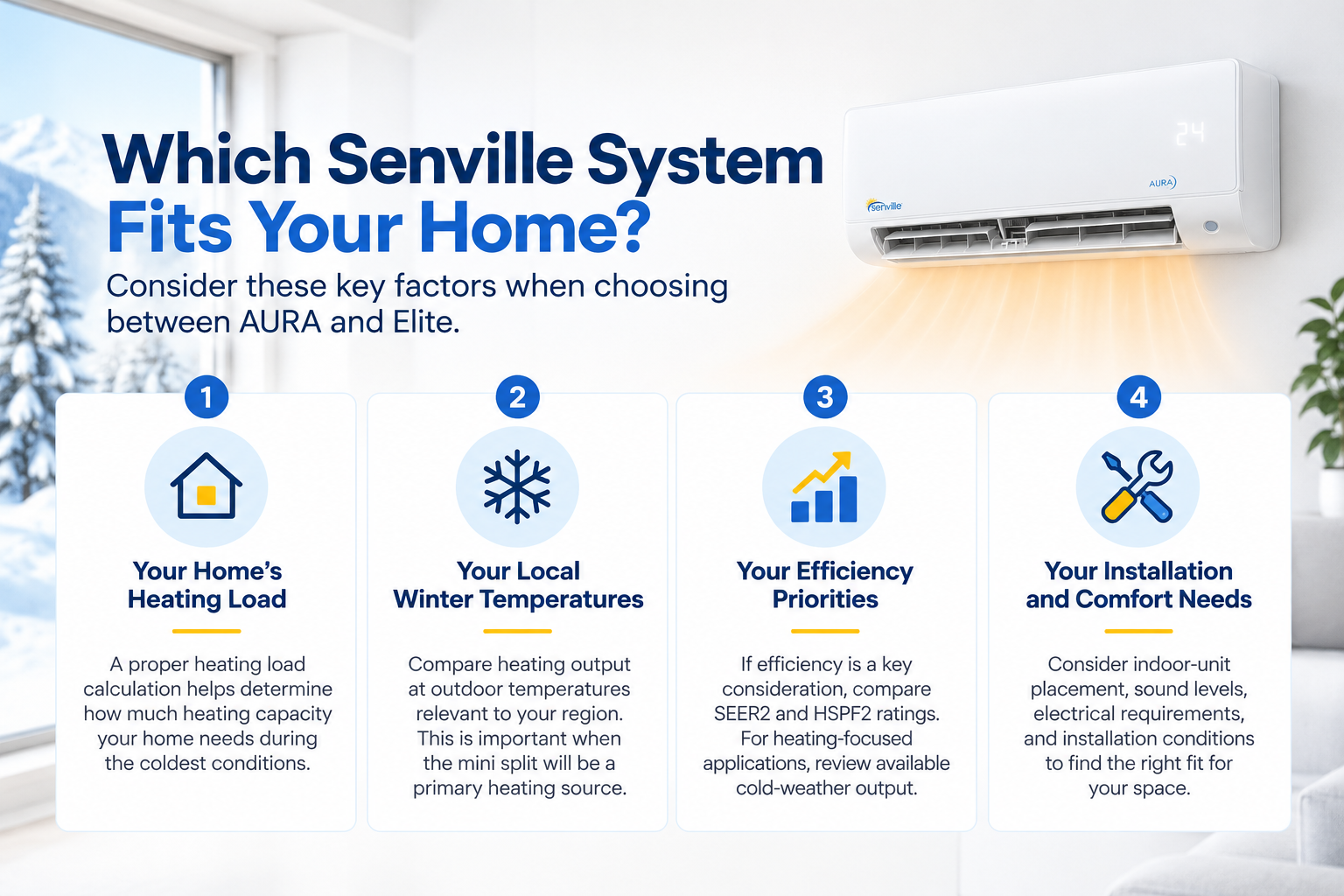
The best approach is to start with the requirements of the space rather than selecting a series based on one specification.
Here are four factors worth reviewing.
Your Home's Heating Load
A properly calculated heating load helps determine how much heating capacity is needed during the coldest expected conditions. A qualified HVAC professional can perform a Manual J load calculation to help establish the appropriate system size.
Your Local Winter Temperatures
Consider the heating output available at outdoor temperatures relevant to your region. This is especially important when the mini split will serve as a primary heating source.
Your Efficiency Priorities
If seasonal cooling efficiency is a major consideration, compare SEER2 ratings. For heating-focused applications, review HSPF2 alongside the system's available cold-weather heating capacity.
Your Installation and Comfort Requirements
Indoor-unit placement, airflow, sound levels, electrical requirements, and installation conditions all influence the overall system selection.
A model with a higher specification in one category isn't necessarily the best fit for every home.
7. AURA vs. Elite: Which Should You Consider?
Based on the specific models evaluated in the technical comparison:
| If Your Priority Is... | Model Worth Comparing |
|---|---|
| Higher SEER2 at 9K, 12K, 18K, or 24K | Elite |
| Greater heating output at -22°F in 9K, 12K, or 18K | Elite |
| Greater heating output at -22°F in 24K | AURA |
| Higher HSPF2 in 24K | AURA |
| Lower listed minimum sound level in 18K | Elite |
| Lower listed minimum sound level in 24K | AURA |
These are comparisons of the models represented in the technical report, not blanket recommendations for every Senville AURA or Elite configuration.
Frequently Asked Questions
Is the Senville Elite Series more efficient than AURA?
The Elite models in this comparison have higher SEER2 ratings across 9K, 12K, 18K, and 24K capacities. Elite also has higher HSPF2 ratings at 9K, 12K, and 18K, while AURA has the higher HSPF2 rating at 24K.
Which Senville series performs better in extreme cold?
It depends on the capacity. At -22°F, the Elite 9K, 12K, and 18K models deliver greater heating output, while the AURA 24K delivers more heating output than the corresponding Elite model.
Can AURA and Elite heat a home during winter?
Both series include cold-climate heat pump models. Whether a particular system can meet a home's full winter heating requirements depends on the home's heating load, the equipment's capacity at low outdoor temperatures, and the installation design.
Is a higher SEER2 rating always better?
A higher SEER2 rating indicates greater standardized seasonal cooling efficiency. However, homeowners should also consider heating efficiency, cold-weather output, equipment sizing, and their specific comfort needs.
Does a 24,000 BTU system always provide 24,000 BTU/h of heat?
No. Heating output changes with outdoor conditions and equipment operation. The 24K AURA model in this comparison, for example, has a listed rated heating output of 29,000 BTU/h and delivers 13,400 BTU/h at -22°F.
Find the Right Senville Heat Pump for Your Home
Both the Senville AURA and Elite Series offer cold-climate heating and cooling options, but their performance advantages vary by capacity.
The Elite models evaluated here stand out for seasonal cooling efficiency and low-temperature heating output at 9K, 12K, and 18K. At 24K, AURA offers greater heating output in the cold-weather conditions examined, along with a lower listed minimum sound level.
Before making your selection, compare the exact model specifications and consult a qualified HVAC professional to ensure the system is appropriately sized for your home.
Explore Senville's Cold-Climate Heat Pumps
Compare available systems and find the right fit for your home's heating and cooling needs.
Explore Senville Mini SplitsPerformance figures are based on the specific AURA and Elite models evaluated in the supplied technical comparison. Ratings and heating output vary by model and operating conditions. Confirm all specifications using the applicable product submittal before purchasing.